
Literacy Intervention for Children | Reading, Spelling & Dyslexia Support
Evidence-based, individualised literacy intervention for primary and secondary school students in the Redlands Coast including Thorneside, Birkdale, Wellington Point, Ormiston, Cleveland, Thornlands, Victoria Point, Capalaba, Mt Cotton and Alexandra Hills, supporting reading, spelling, dyslexia, dysgraphia, reading comprehension and written language.
What is literacy intervention?
Literacy intervention is targeted support for school-aged children and teenagers experiencing difficulties with reading, spelling, written language or reading comprehension, including children with dyslexia and dysgraphia.
Effective literacy intervention involves structured, explicit and systematic teaching of the particular skills a child needs to develop. Depending on the child’s individual learning profile, intervention may target phonological awareness, decoding, spelling and encoding, word reading, reading fluency, vocabulary, morphology, sentence construction, reading comprehension and written language.
At Triple L Speech Pathology and Audiology, literacy intervention is individually tailored following assessment. Our clinicians are trained in multiple evidence-based literacy programs and approaches, allowing intervention to be selected according to each child’s particular strengths and areas of difficulty rather than applying the same program to every learner.


Who can benefit from literacy intervention?
Literacy intervention may support school-aged children and teenagers who experience ongoing difficulties with:
- Reading and decoding
- Spelling and encoding
- Reading fluency
- Reading comprehension and text analysis
- Written sentence construction
- Planning, sequencing, writing and editing written language
- Vocabulary and language comprehension
- Study skills and language-based problem-solving
- Language and phonological processing skills that affect literacy development
Triple L provides literacy support for primary and secondary school students, including children with dyslexia, dysgraphia, Developmental Language Disorder (DLD), auditory processing difficulties and other complex learning profiles.
Early identification matters
Literacy development begins before formal reading instruction, and some children demonstrate early signs that they may be at risk of later reading and spelling difficulties.
Identifying these concerns early allows appropriate support to begin as soon as possible and can help prevent learning gaps from becoming increasingly difficult to address as academic demands increase.
What literacy approaches and programs do we use?
Our Speech Pathologists have training and experience across a range of evidence-based literacy programs and approaches, including:
- Sounds-Write
- Read3
- Heggerty Phonemic Awareness
- The Writing Revolution
- VCOP
Depending on the child’s needs, intervention may also incorporate systematic synthetic phonics, explicit teaching of decoding and encoding, phonological awareness, morphology, multisyllabic word reading and spelling, reading fluency, vocabulary, reading comprehension, sentence construction and written language development.
Our approach is informed by current evidence regarding literacy development and the Science of Reading.
Rather than applying one literacy program to every learner, our clinicians draw on different evidence-based approaches and strategies according to the individual child’s strengths, needs and learning profile.


Why is literacy more than reading and spelling?
Literacy difficulties do not always occur in isolation.
Although reading and spelling are important components of literacy, successful literacy development also draws on a child’s broader oral language, communication and learning skills.
These may include phonological processing, vocabulary, syntax and grammar, verbal reasoning, oral language comprehension and written language.
Difficulties in these areas can affect how efficiently a child learns to read, how well they understand increasingly complex texts and how effectively they communicate their own ideas in writing.
This broader understanding is particularly important for children whose difficulties extend beyond learning to decode or spell individual words.
What makes Triple L’s approach to literacy different?
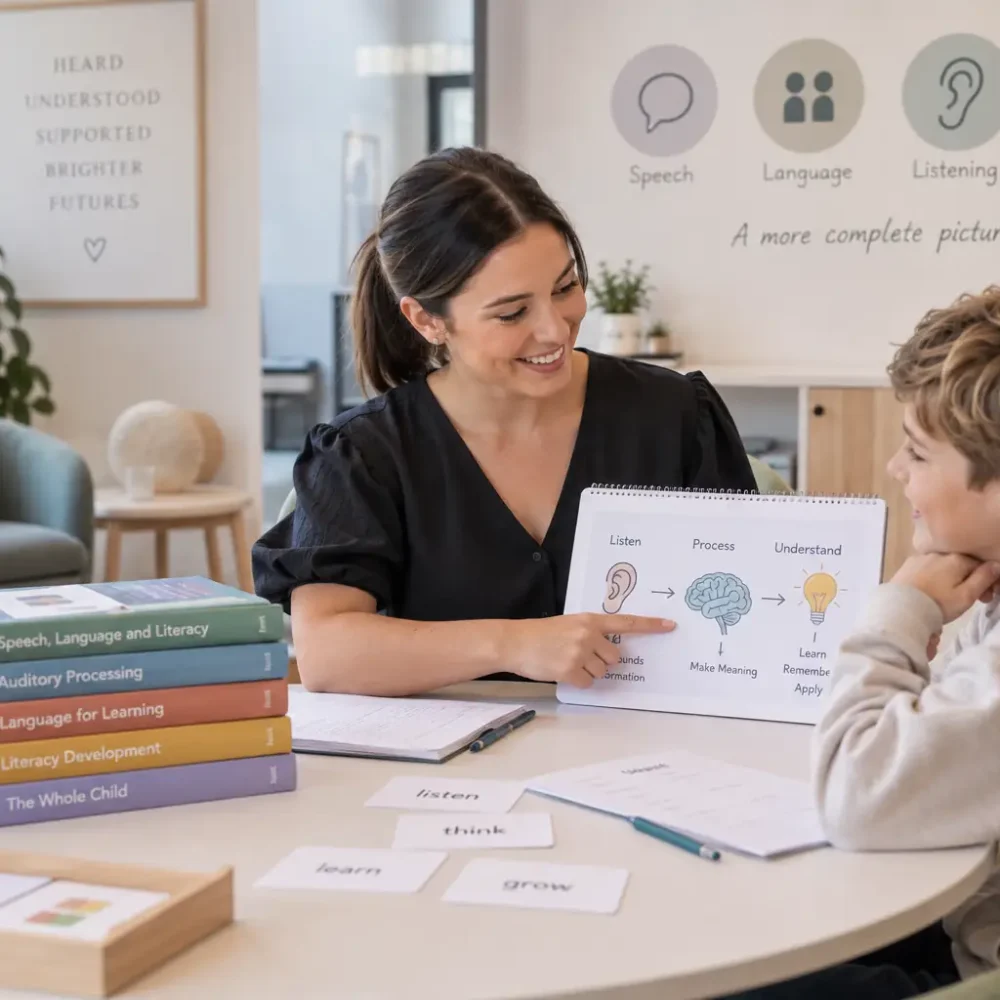
Triple L is a combined Speech Pathology and Audiology practice, allowing our clinicians to consider literacy within the broader context of a child’s speech, language, communication, listening and auditory processing profile.
For some children, literacy difficulties occur alongside challenges with oral language, phonological processing, vocabulary, sentence structure, verbal reasoning, listening or auditory processing.
Bringing these areas together allows our clinicians to consider how a child’s language, listening, auditory processing and literacy skills may interact, rather than viewing reading and spelling difficulties in isolation.
This broader clinical perspective can be particularly valuable for school-aged children and teenagers with complex learning profiles, including those with Developmental Language Disorder (DLD), auditory processing difficulties, dyslexia or dysgraphia.

How is literacy intervention tailored to each child?
There is no single approach or program that is right for every learner.
Following assessment, literacy intervention is individually tailored according to the child’s particular strengths and areas of difficulty.
Depending on their individual needs, intervention may target:
- Phonological awareness and phonological processing
- Decoding and word reading
- Spelling and encoding
- Morphology
- Multisyllabic word reading and spelling
- Reading fluency
- Vocabulary and oral language
- Sentence structure and grammar
- Reading comprehension and text analysis
- Study skills and language-based problem-solving
- Planning and organising written work
- Written language and editing
For example, one child may require greater support with phonological awareness, decoding and spelling, while another may decode accurately but require greater emphasis on vocabulary, language comprehension, inferencing, text analysis or written expression.
Intervention can therefore change as the child develops and as their literacy and academic demands increase.
Literacy intervention for primary and secondary school students
Literacy difficulties can look very different as children progress through school.
In the early primary years, intervention may focus more heavily on phonological awareness, decoding, spelling, word reading and sentence development.
For older primary and secondary school students, intervention may increasingly address multisyllabic word reading and spelling, morphology, vocabulary, complex sentence construction, reading comprehension, inferencing, text analysis, planning and organising written work, editing and study skills.
This allows intervention to remain relevant to the literacy demands the student is experiencing at school.


What is the goal of literacy intervention?
Our goal is not simply to teach children to read individual words.
We aim to help children and teenagers develop the language and literacy skills they need to read, understand, communicate and participate more successfully in learning at school.
Intervention therefore focuses on the individual skills that are limiting the child’s literacy development while progressively supporting their ability to apply those skills to increasingly meaningful reading and writing tasks.
Literacy Intervention in Cleveland and the Redlands
Triple L provides literacy assessment and individualised literacy intervention in Cleveland, Queensland, for primary and secondary school students from across the Redlands and surrounding areas.
Our Cleveland clinic supports families from areas including Cleveland, Ormiston, Thornlands, Alexandra Hills, Wellington Point, Victoria Point and surrounding Redlands suburbs.
How do we get started?

The first step is to develop a clear understanding of your child’s literacy, language and learning profile.
Triple L provides comprehensive literacy assessments in Cleveland for children and teenagers experiencing difficulties with reading, spelling, written expression and reading comprehension, including assessment for dyslexia and dysgraphia where clinically appropriate. These difficulties may also be described diagnostically as Specific Learning Disorder with impairment in reading and/or written expression.
Assessment helps identify the child’s particular pattern of strengths and areas of difficulty and provides an evidence-based starting point for planning individualised intervention.
Depending on your child’s profile, assessment may also consider related speech and language skills. An auditory processing assessment may be recommended where there are concerns regarding listening or auditory processing.
Where language, listening or auditory processing difficulties are identified, these may also need to be considered when planning intervention, as they can affect a child’s ability to access and develop literacy skills.
You can find further information about our assessment options on our Speech, Language and Literacy Assessments page.
Following assessment, we can discuss the findings with you and recommend the most appropriate next steps, including whether individualised literacy intervention may be beneficial.